Before beginning your PSS certification application, it’s important to understand which clinical eligibility criteria you fall under. The Texas Certification Board offers five different applications depending on your clinical and supervisory experience.
As outlined by the Texas Administrative Code, a Peer Specialist Supervisor must be one of the following:
- QCC (Qualified Credentialed Counselor)
- LPHA (Licensed Practitioner of the Healing Arts)
- QMHP-CS (Qualified Mental Health Professional – Community Supervision), supervised under a QCC or LMHP
- QPS, supervised under a QCC or LMHP
However, these titles can be confusing, and it may be difficult to determine which category applies to you. This section will outline what each of these categories are, as well as what application you should use for those respective categories.
Qualified Credentialed Counselor (QCC)
A Qualified Credentialed Counselor is a person with one of the following clinical licenses, and practices within the authorized scope of that license:
- Licensed professional counselor
- Licensed clinical social worker
- Licensed marriage and family therapist
- Psychologist
- Physician
- Physician’s assistant
- Licensed chemical dependency counselor
- Certified addictions registered nurse
- Advanced practice nurse (recognized by the Board of Nurse Examiners as a clinical nurse specialist or practitioner with a specialty in psychiatric-mental health nursing)
If you hold any of the licenses listed above, you qualify as a QCC. As a QCC, you may complete Peer Specialist Supervisor training without further education or supervision. A QCC is also qualified to supervise other types of Peer Specialist Supervisors, described below.
After completing the two-day PSS training, QCC applicants should use the certification application titled “PSS-QCC or LPHA”.
Licensed Practitioner of the Healing Arts (LPHA)
A Licensed Practitioner of the Healing Arts is a person with one of the following clinical licenses, and practices within the authorized scope of that license:
- Physician
- Licensed professional counselor
- Licensed clinical social worker
- Psychologist
- Advanced practice registered nurse
- Physician assistant
- Licensed marriage and family therapist
If you hold any of the aforementioned licenses, you will qualify as a LPHA. As a LPHA, you may complete Peer Specialist Supervisor training without further education or supervision. A LPHA is also qualified to supervise other types of Peer Specialist Supervisors, described below.
After completing the two-day PSS training, LPHA applicants should use the certification application titled “PSS-QCC or LPHA”.
Qualified Mental Health Professional – Community Supervision (QMHP-CS), with a QCC or LPHA Supervisor
A Qualified Mental Health Professional – Community Services (QMHP-CS) is a person with qualifying college education in select fields, a licensed registered nurse, or a combination of both. QMHP-CS is often shortened to QMHP, so if you see “QMHP,” it is referring to QMHP-CS.
In order to qualify as a QMHP, one must meet at least one of the following requirements:
1. Hold a bachelor’s degree from an accredited college or university with a minimum number of hours that are equivalent to a major in:
- Psychology
- Social Work
- Medicine
- Nursing
- Rehabilitation
- Counseling
- Sociology
- Human Growth And Development
- Physician Assistance
- Gerontology
- Special Education
- Educational Psychology
- Early Childhood Education
- Early Childhood Intervention.
2. Be a Licensed Registered Nurse
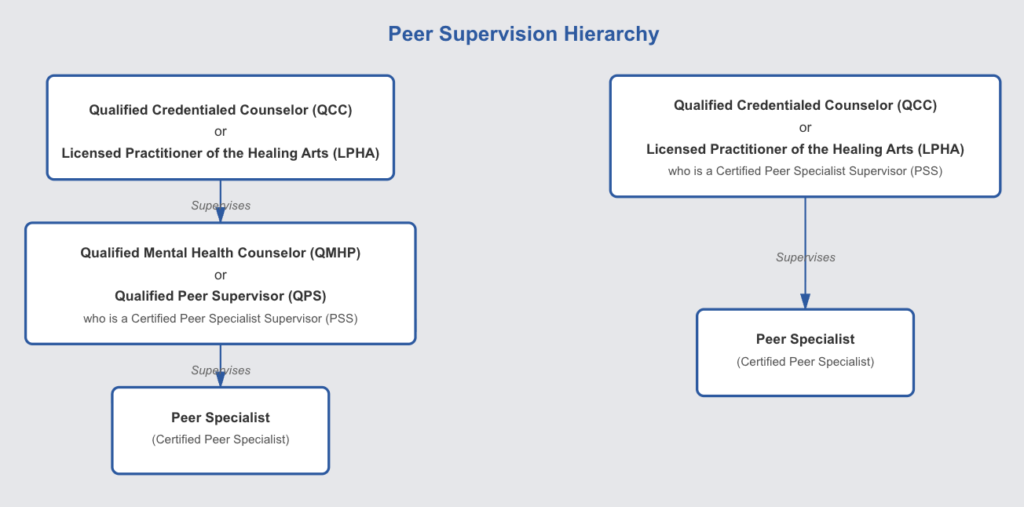
As a QMHP seeking PSS certification, you must be supervised by someone who falls under the QCC or LPHA categories. To better understand the supervision structure, please see the flowchart at the end of this section.
Additionally, there are two PSS applications for QMHP, depending on which eligibility category you meet. After completing your two-day PSS training,
- If you have a bachelor’s degree, choose the certification application titled “PSS – QMHP-CS w/Degree under QCC or LPHA”
- If you are a licensed registered nurse, choose the certification application titled “PSS – QMHP-CS w/License under QCC or LPHA”
- If you meet both criteria, choose one application pathway.
Qualified Peer Specialist (QPS), with a QCC or LPHA Supervisor
A Qualified Peer Specialist is a person who is certified as a peer specialist and has some level of education, work experience as a peer specialist, or a combination of the two. For the purposes of this qualification, a peer specialist includes a Mental Health Peer Specialist, Recovery Support Peer Specialist, or Certified Family Partner.
There are two specific categories that identify one as a Qualified Peer Specialist:
1. You have a GED or high school diploma, and at least four years of work experience as a peer specialist
or;
2. An associate degree or higher from an accredited university, and at least two years of experience as a peer specialist.
As a QPS seeking certification as a PSS, you must also be supervised by someone who falls under the QCC or LMHP categories. To better understand the supervision structure, please see the flowchart at the end of this section.
Additionally, there are two PSS applications for a QPS, depending on which eligibility category you meet. After completing your two-day PSS training,
- If you have a GED/high school diploma and at least four years of work experience, choose the certification application titled “PSS – Peer Specialist w/out Degree”
- If you have an associate degree or higher and at least two years of work experience as a peer specialist, choose the certification application titled “PSS – Peer Specialist w/ Degree”
Here is a quick flowchart that shows the two TAC compliant oversight structures for peer specialists: