Built for individuals in mental health recovery who want to turn their journey into professional expertise. This is where people who’ve navigated their own challenges learn to guide others toward hope and healing.
Complete your 40-hour MHPS supplemental training in just 5 days
Learn from certified facilitators who share your lived experience
Master peer support skills: storysharing, crisis support, advocacy & documentation
Practice real-world skills through interactive exercises and role-play scenarios
Get step-by-step guidance through the full Texas certification process


100% Virtual

Peers Certified
Investment
$800
Features
Path to becoming a Mental Health Peer Specialist
Training certificate included
Scholarships available
Details
8 hours a day for 5 days
40 Hours
9 am to 5 pm CT
A Mental Health Peer Specialist is a person who has lived experience of recovery with mental health challenges who is trained to support people with mental health challenges. They provide support by honoring the self-identification and self-determination of the people receiving peer services, without focusing on or using clinical language or diagnoses.
Recovery and wellness support, which includes providing information on and support with planning for recovery;
Mentoring, which includes serving as a role model and providing assistance in finding needed community resources and services; and
Advocacy, which includes providing support in stressful or urgent situations, and helping to ensure that the recipient’s rights are respected.
This is a complete 40-hour certification training that gives you the skills, ethics, and confidence to provide professional mental health peer support. You’ll learn how to share your story purposefully, support others through crisis, and navigate the Texas certification process with clarity.
From ethics to advocacy, you’ll graduate with the knowledge and skills employers are actively seeking.
Understanding the history of mental health treatment and the peer support movement and how it shapes the work you’ll do today.
Applying peer support principles and ethics to real-world situations using the peer voice and choice framework.
Sharing your lived experience purposefully through ethical, boundaried storysharing that supports without oversharing.
Navigating power dynamics and supporting autonomy using language that honors self-determination.
Building essential skills: active listening, holding space, group facilitation, crisis support, and advocacy.
Individuals in mental health recovery ready to turn their lived experience into professional expertise.
Volunteers at recovery centers or peer-run organizations looking to formalize their skills.
People seeking stable, meaningful work that accommodates their recovery journey.
Job seekers who want their mental health history to be an asset, not a barrier.
Anyone called to help others navigate challenges they’ve personally overcome.
If you’re ready to transform your lived experience into a credential that opens doors, this is the training Texas employers recognize and trust.
This is a complete 40-hour certification training that gives you the skills, ethics, and confidence to provide professional mental health peer support. You’ll learn how to share your story purposefully, support others through crisis, and navigate the Texas certification process with clarity.








Be at least 18 years of age;
Have lived experience with mental health
Have a high school diploma or General Equivalency Diploma (GED)
Be willing to appropriately share your own recovery story with recipients
Be able to demonstrate current self-directed recovery
Pass criminal history and registry checks
Texas Resident or someone who spends atleast 51% of their time working in Texas in-person or remotely.
Criminal justice settings (jails, prisons, specialty courts, probation and parole, etc.)
Community outreach programs (where peer supporters go into the communities where people live)
Hospitals and Inpatient Treatment Centers (psychiatric hospitals, general medicine hospitals, substance use treatment centers, and Veterans Administration hospitals)
Outpatient clinics (Federally Qualified Health Clinics, mental health clinics, substance use treatment clinics)
Peer-run organizations (Consumer-Operated Service Providers, Recovery Community Organizations, and other groups that are run by peer supporters and/or people in recovery)
Residential settings (domestic violence shelters, residential settings for people in substance use recovery, shelters or residential settings for people experiencing homelessness, etc.)
Virtual settings (app-based services, teleconferencing, chat-based support, etc.)
And many more!
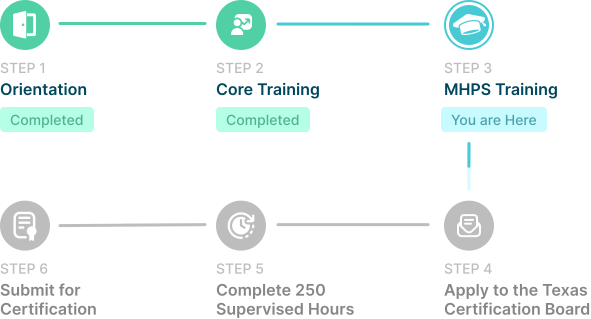
The certification process for Mental Health Peer Specialists in Texas involves taking formal training with a certified training entitiy, and completing a supervised internship period. During this internship, individuals receive supervision and support from a Peer Specialist Supervisor.
Full certification can be achieved in as little as 8 months, but may take up to a year to complete the work experience hours and application process, depending on the individual’s rate of completion.
The Core training is a 3-day 24 hour, online training that will give you a comprehensive overview of what peer support is, and what peer specialists do, and familiarize you with the role and functions of a Peer Specialist.
Our 40-hour, 5-day MHPS Supplemental training is available 100% online and helps you learn and practice the essential skills for a Mental Health Peer Specialist. To move forward with your state application, you must also pass a knowledge assessment at the end of the course
After completion of Core and MHPS training, you can start your application with the Texas Certification Board (TCB) for your 6-month initial peer certification.
TCB uses a digital application called Certemy that you will be uploading information into for the duration of your internship and supervision period.
After being approved by the Texas Certification Board, you will need to complete 250 internship hours under the supervision of a certified Peer Specialist Supervisor (PSS), either in-person or online.
These internship hours can be done on the job or in a volunteer position, as long as they are signed off by a Peer Specialist Supervisor and logged in your Certemy application. Certemy will walk you through how to give PSS access to your application to log your work experience hours.
After completing the necessary internship hours, you will need to complete and submit your Certemy application for the second phase full certification. Include your Peer Specialist Supervisor’s information, all hours logged, and a Letter of Recommendation from your PSS.
After completing your 250 hours, ask your PSS for a Letter of Recommendation. Upload this to your Certemy account and submit it for approval.
Wait for certification; you will be notified by the TCB when your application has been reviewed and approved and will be sent your official Peer Specialist Certification. Note that your certification must be renewed every 2 years.
Learn more about each of these steps with this step-by-step guide. We break down every step of the MHPS certification process with helpful links and FAQs from the peers we have helped.
This is a complete 40-hour certification training that gives you the skills, ethics, and confidence to provide professional mental health peer support. You’ll learn how to share your story purposefully, support others through crisis, and navigate the Texas certification process with clarity.
Day 1
Introduces participants to the training environment, establishes group guidelines, and facilitates introductions among facilitators and participants.
Introduces participants to the training environment, establishes group guidelines, and facilitates introductions among facilitators and participants.
Explores how the history of mental health systems has created a culture of patienthood, connects lived experience to multiple pathways of recovery, and differentiates between treatment and recovery concepts.
Reviews the core principles of Texas peer professionals, distinguishes actions that align with or conflict with peer support principles, and interprets ethical requirements through peer support principles.
Day 2
Covers employing concepts of autonomy and power in peer support, analyzing actions through the four types of power (power over, power with, power to, and power within), and using strengths-based, non-clinical language.
Covers employing concepts of autonomy and power in peer support, analyzing actions through the four types of power (power over, power with, power to, and power within), and using strengths-based, non-clinical language.
Focuses on understanding and applying informed consent principles within mental health peer support relationships.
Covers dream exploring and goal planning skills, including facilitating conversations around planning with persons served.
Day 3
Explores establishing and maintaining appropriate professional boundaries in peer support relationships.
Explores establishing and maintaining appropriate professional boundaries in peer support relationships.
Focuses on the purposeful and effective sharing of personal recovery stories to support others.
Covers crisis support skills, trauma-informed approaches, and supporting individuals during difficult experiences.
Explores advocating with and advocating for persons served within mental health systems.
Day 4
Focuses on skills and best practices for facilitating peer support groups.
Focuses on skills and best practices for facilitating peer support groups.
Provides in-depth exploration of values and ethics in peer specialist practice through case-based learning.
Offers hands-on practice integrating all peer support skills learned throughout the training.
Day 5
Covers recognizing, addressing, and protecting against role drift in peer specialist work.
Covers recognizing, addressing, and protecting against role drift in peer specialist work.
Focuses on maintaining professional wellness, including developing personal purpose and mission statements.
Introduces documentation practices, recovery planning, and proper record-keeping for peer specialists.
Wraps up the training with closing presentations and activities, preparing participants for the certification process.
The cost of Core Training is $300.
The cost of RSPS Supplemental Training is $800.
Yes! Peer Academy offers scholarships covering up to 100% of training costs. Many students complete their training completely free. Money should never be a barrier to pursuing this career path.
The time to obtain full MHPS certification typically ranges from 6 months to a year, depending on how quickly you complete the training and the 250 hours of supervised work experience.
Yes, the MHPS training is offered in a virtual format, allowing you to participate from anywhere in Texas with a reliable internet connection.
No. The minimum educational requirement is a high school diploma or GED.
Mental Health Peer Specialists are not clinicians. While therapists diagnose and treat mental health conditions, peer specialists use their personal lived experience to offer hope, support self-determination, and help people navigate their own recovery journey. Peer support is relationship-focused, not treatment-focused.
Transform your lived experience into a meaningful career. Join 100+ peers who’ve made the journey.