
Texas Peer Support Orientation and Self-Attestation - Orientation and Self-Assessment for Texas Peer Specialists
Your First Step to Becoming a Certified MHPS or RSPS Peer Specialist in Texas
Completing this Texas Peer Support Orientation and Self-Attestation is the first step to becoming a certified Mental Health Peer Specialist (MHPS) or Recovery Support Peer Specialist (RSPS) in Texas. This Orientation and Self-Assessment for Texas Peer Specialists will provide you with an overview of the career field, help you gauge your readiness, and ensure that you meet the eligibility requirements needed to obtain your certification.
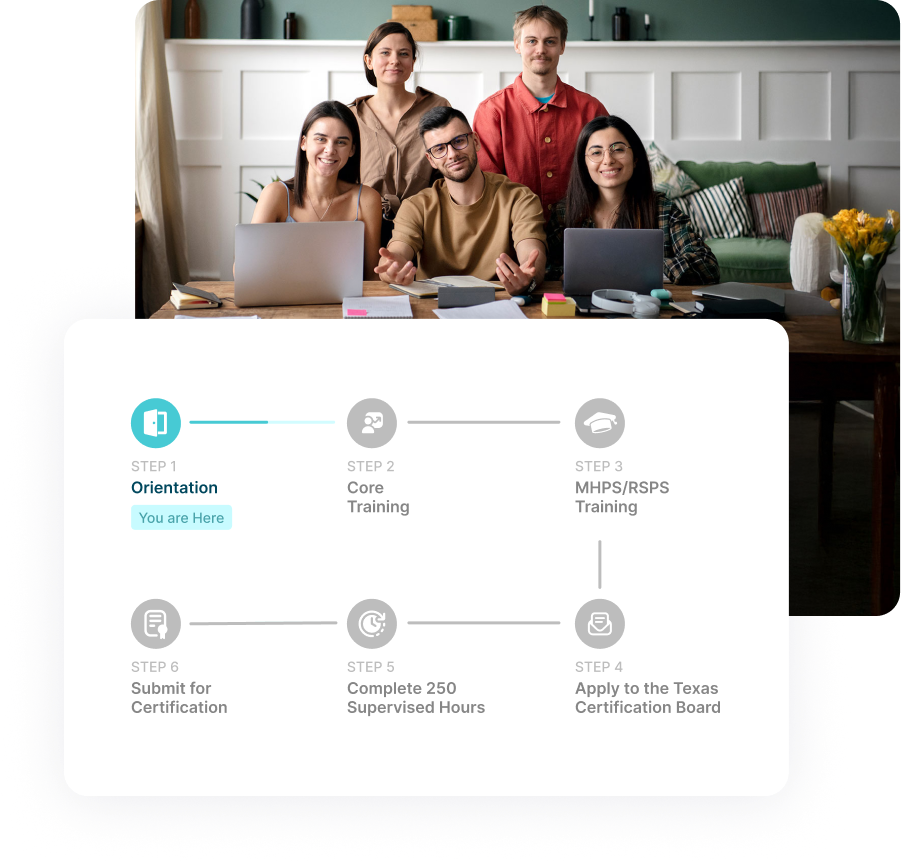
What to Expect in This Texas Peer Support Orientation and Self-Attestation
Self-Assessment
Reflect on your recovery journey and readiness for peer specialist training
Readiness Check
Review statements about MHPS and RSPS training expectations
Qualifications
Confirm you meet Texas peer specialist certification requirements
Attestation
Sign and download your orientation completion certificate
What is a Peer Specialist in Texas?
Peer specialists help instill the hope of recovery from behavioral health challenges or dual diagnosis. They use their lived experience to help others engage in recovery.
To become a certified Mental Health Peer Specialist (MHPS) or Recovery Support Peer Specialist (RSPS) in Texas, you must complete a training program and pass written exams. This Texas Peer Support Orientation and Self-Attestation helps you determine if this rewarding career path is right for you.
Recognized by: Texas Health and Human Services Commission (HHSC) for MHPS and RSPS Certification
Self-Assessment Questions for Texas Peer Specialists
The peer specialist training draws strongly on a person's lived experience and recovery journey. Please reflect on the following questions as part of your Orientation and Self-Assessment for Texas Peer Specialists:
These questions are optional but encouraged to help you reflect on your readiness for MHPS or RSPS certification.
Readiness Check for Texas Peer Specialist Certification
This training can be intense and emotional. Please gauge your agreement with the following statements to decide if peer specialist training is right for you at this point in your life:
* All statements below are required to proceed
Minimum Qualifications
To be a peer specialist who bills Medicaid in Texas you must:
- Be at least 18 years of age
- Have lived experience with a mental health condition, substance use issue, or both
- Have a high school diploma or General Equivalency Diploma
- Be willing to appropriately share your recovery story
- Be able to demonstrate current self-directed recovery
- Pass criminal history and registry checks
Orientation Resources
Are you considering becoming certified to provide peer support services in Medicaid? Here's some information to get you started.
Description of Peer Specialist Services
Concept of Recovery
Evidence Base for Peer Support
- Peers - Substance Abuse and Mental Health Services Administration (SAMHSA)
- The Peer Specialist Workforce in Texas: Training and Certification, Workforce Outcomes, and Workforce Integration (PDF) - Texas Institute for Mental Health, School of Social Work, The University of Texas at Austin
- Recovery Supports Services Project, Fiscal Year 2017 Final Evaluation Report (PDF) - Addiction Research Institute, The Steve Hicks School of Social Work, The University of Texas at Austin
Typical Workday
Employment Demographics and Careers
Review Your Responses & Download Attestation
Attestation of Completion
Complete the form below to generate your signed attestation document.
Attestation of Completion
I have considered the statements in the self-assessment and viewed the content in the orientation.
Sign using your mouse or finger on touchscreen
Type your full name to create a signature
Next Steps
After downloading your attestation:
- Save the PDF for your records
- When applying for training, fill out the Peer Specialist Training Application and attach this PDF
For additional support, visit the Peer Academy Knowledge Base - Certification Resources.